Playful Reindeer Trio
First Impression: Festive, Friendly, and Instantly Recognizable
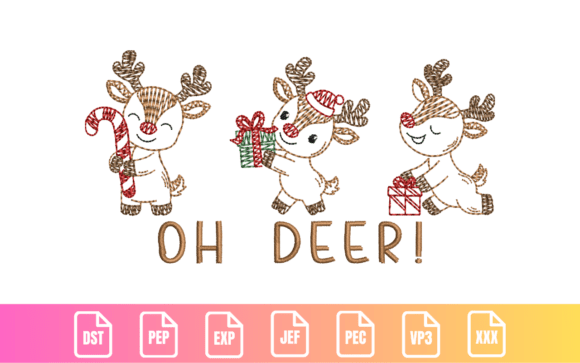
As an embroidery designer who’s prepped over 200 craft fair booths, I can tell you—Playful Reindeer Trio lands exactly where it needs to: warm, joyful, and unmistakably Christmas. It doesn’t try to be minimalist or vintage-chic. It leans into cheerful storytelling—three distinct reindeer, each with a holiday prop (candy cane, gift, and that lovely “sharing Christmas” sentiment). That’s not just decoration; it’s emotional shorthand. At a crowded handmade market, this design stops browsers in their tracks—not with boldness, but with charm. It reads as handmade, heartfelt, and ready for gifting.
Where Playful Reindeer Trio Shines on Craft Fair Products
This machine embroidery design thrives where personality meets practicality. On tote bag designs, it works best centered near the bottom hem—large enough to read from three feet away, yet balanced so the bag still feels clean and carryable. For apron embroidery, place it just above the pocket: the trio’s horizontal flow fits naturally across the chest panel, and customers love how it personalizes a functional item. With tea towel embroidery, keep it small and top-aligned—avoid centering over thick hems or textured weaves where stitch definition might blur.
Embroidered patches are where Playful Reindeer Trio becomes a bestseller. Trimmed and heat-applied, it adds instant holiday spirit to denim jackets, knit caps, or even children’s backpacks. As a pillow cover design, it holds up beautifully when scaled to 4–5 inches wide—just large enough to read, small enough to preserve fabric drape. And for small pouches and market bags, it performs better as a single focal point (not repeated) to avoid visual clutter.
What Makes It Sell—And What Requires Caution
Customers respond to clarity, contrast, and charm—and Playful Reindeer Trio delivers all three… if executed thoughtfully. Its strength lies in strong silhouettes and expressive poses—no tiny facial details that vanish at 3-inch scale. That said, watch for potential pitfalls: the “sharing Christmas” text is likely delicate. If the original embroidery file includes small lettering, test it at 2.5 inches wide on cotton twill before cutting production runs. Also, dense stitch areas—especially around the candy cane swirl or gift bow—can pucker on lightweight fabrics or stiffen textured towels. Always use cutaway stabilizer for high-stitch-density zones.
On dark fabric? Prioritize high-contrast thread colors—think white, ivory, or metallic silver instead of light red or green. And for curved surfaces like caps, avoid placing the full trio across the front panel; instead, opt for one reindeer + partial text as a subtle accent. The design’s horizontal orientation makes it less ideal for tall, narrow spaces—skip it for skinny tea towel borders or vertical zipper pulls.
Photography, Listings, and Online Appeal
This is a standout digital embroidery file for Etsy sellers and small shop owners because it photographs exceptionally well. The trio’s balanced spacing and clear props translate cleanly into printable mockups. No need for heavy filters—natural light shows off thread sheen and stitch texture. Use flat-lay shots with real products: a folded tea towel beside a matching pouch, or an apron draped over a wooden stool with cinnamon sticks nearby. That context signals “handmade product,” not just a design asset.
For your Etsy listing, lead with lifestyle images—not isolated hoop shots. Customers buy the feeling, not the file. And yes, Playful Reindeer Trio feels repeatable: its consistent proportions and moderate stitch count (assuming standard density) support efficient batch production without sacrificing quality. Just confirm the hoop size matches your most-used frame—ideally 4x4 or 5x7—to minimize re-hooping between tote bags and pillow covers.
Booth Impact and Buyer Engagement
In person, Playful Reindeer Trio strengthens your entire craft fair product display. Hang a finished tote bag at eye level. Drape an apron over a ladder shelf. Pin a patch sample to a corkboard next to a “make your own” station. These aren’t just items—they’re conversation starters. Shoppers ask, “Are those all the same design?” or “Can you do my kid’s name with the reindeer?” That’s engagement you can’t fake. The design also supports brand consistency: pair it with a simple serif font for tags, use coordinating red-and-cream thread palettes across all items, and unify your booth with natural wood signage and kraft packaging.
Essential Designer Notes Before You Stitch
- Test on scrap fabric first—especially if using terry cloth, linen blends, or quilt-weight cotton.
- Check thread contrast on both light and dark fabric swatches; some greens and reds fade into background tones under booth lighting.
- Review spacing between reindeer figures—if too tight, they’ll merge visually on textured surfaces.
- Confirm hoop size and design dimensions match your production workflow—don’t assume compatibility.
- Inspect stitch density in the gift wrap and candy cane details; overly dense fills may require reduced density settings or alternate fill patterns.
- Use the right stabilizer: cutaway for knits and stretchy fabrics, tear-away for stable wovens, and fusible for lightweight linens.
- Create at least one real mockup—not digital—so you see how light, shadow, and hand-feel affect perceived quality.
- Compare fabric colors side-by-side; dye lots vary, and what looks festive on screen may feel muted in person.
- Confirm commercial licensing before selling finished products—this is non-negotiable for any commercial embroidery use.
Final Thought: A Holiday Workhorse, Not a One-Season Gimmick
Playful Reindeer Trio isn’t just another Christmas embroidery design—it’s a versatile, emotionally resonant asset built for real-world making. It balances whimsy with wearability, charm with clarity, and festivity with finish. When stitched with intention and displayed with care, it turns everyday handmade goods into memorable gifts—and transforms your craft fair booth from “nice” to “must-stop.” Just remember: great design begins long before the needle drops. Test, tweak, and trust your instincts. Then stitch with joy.